The ohm rating on your coil tells you, before you take a single puff, what kind of vape you are in for. Under 1.0 ohm means a loose lung hit and plenty of vapour; 1.0 ohm and above means a tighter, cigarette-style draw. Get it right and everything else, from liquid to wattage, falls into place.
The short version
- Ohms measure resistance. Lower ohms pull more power and make more vapour.
- Below 1.0 ohm is sub-ohm (direct to lung). 1.0 ohm and up is MTL territory.
- 0.6 to 0.9 ohm is the restricted lung middle ground most pod kits now use.
- Match the liquid: 50/50 or nic salts for high ohms, 70/30 shortfills for sub-ohm.
Ohms in plain English
An ohm is a unit of electrical resistance. Your coil is a short length of resistance wire, and the ohm figure printed on it tells your device how hard that wire pushes back against the current from the battery.
Here is the bit that matters: at the same battery voltage, a lower resistance lets more current through, which means more power, more heat and more vapour. A 0.2 ohm coil on a full battery is a small furnace compared with a 1.2 ohm coil on the same battery.
That is why the number is the single best clue to how a coil will feel. You do not need to love maths to use it, you just need to know which side of 1.0 ohm you are on.
Sub-ohm vs MTL side by side
Mouth to lung (MTL) vaping copies a cigarette: you draw vapour into your mouth, hold it a moment, then breathe it in. It runs on higher resistance coils, low power and tight airflow, and it sips liquid.
Direct to lung (DTL), the classic sub-ohm style, skips the mouth stage. You breathe straight in like a deep breath of air, so the coil needs to be low resistance, the airflow wide open and the power high enough to vaporise a lot of liquid per puff.
Neither is better. They suit different people, and plenty of vapers keep one of each: a small MTL pod for the pocket and a sub-ohm tank for the sofa.
Why lower resistance needs more watts
A low resistance coil usually has more metal in it: thicker wire, more wraps, or a wide strip of mesh. More metal takes more energy to heat up, so the recommended power climbs as the ohm figure drops.
The chart shows typical ranges for mainstream coils. Treat them as a starting map, not a rule, because two 0.4 ohm coils from different brands can have quite different sweet spots. The range printed on the side of your coil or its box always wins.
If you want the full walkthrough of finding your best setting, our guide to what wattage to vape at goes coil by coil.
Source: Typical ranges printed on mainstream coils. Your own coil label overrides these.
Which resistance suits you?
Most people already know how they like a draw to feel, even if they have never put it into words. Smokers switching over nearly always prefer something tight. Vapers who started on big tanks tend to find MTL pods frustrating, like breathing through a coffee stirrer.
The middle ground, often called restricted direct to lung (RDL), has exploded in popularity because pod kits like the Vaporesso Xros and Uwell Caliburn G ship with 0.6 and 0.8 ohm options. You get a slightly airy lung hit without needing a big box mod.
Pick the answer that sounds most like you.
How do you want your draw to feel?
Go for 1.0 to 1.2 ohm with the airflow mostly closed, and pair it with a 50/50 or nic salt liquid.
A 0.6 to 0.8 ohm pod or coil is your sweet spot. Try half-open airflow and a 50/50 liquid.
Sub-ohm: 0.15 to 0.4 ohm in a tank, airflow wide, with a 70/30 shortfill at a low nicotine strength.
Start on a 0.8 ohm pod kit with adjustable airflow. It covers both styles well enough to show you which way you lean.
Your liquid has to match the ohms
Resistance and e-liquid are a package deal. Thin 50/50 liquids soak into the small wicking holes of a high resistance coil quickly, which is why they suit MTL. Push a thick 70/30 into a tight 1.2 ohm pod and the cotton cannot keep up, so you get dry hits.
Flip it around and a thin liquid in a hot sub-ohm coil can flood and spit. Sub-ohm coils have big wicking ports designed for thicker, high-VG juice like shortfills.
Nicotine matters too. Strong liquids feel harsh at sub-ohm power because you inhale far more vapour per puff, so most DTL vapers sit at 3 to 6mg. Nicotine is addictive, so choose the lowest strength that keeps you satisfied.
MTL 1.0 to 1.2 ohm
Thin enough for small wicking holes
RDL 0.6 to 0.8 ohm
50/50 also works well
Sub-ohm under 0.5 ohm
Thicker liquid for big ports
Reading the label on your coil
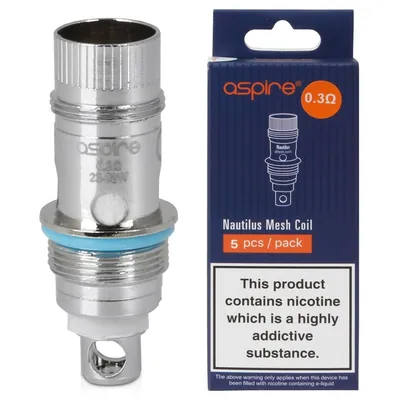
Every coil carries two numbers: its resistance and a power range. A typical label reads something like 0.8 ohm, 12 to 18W. The first number tells you the style, the second tells you where to set the dial.
Some labels add a coil type: mesh, dual, triple or ceramic. Mesh coils heat a wider surface, which tends to give even flavour, and they now dominate the coil range across most brands.
If your kit has no wattage control, the maker has already matched the power to the coil. In that case the ohm figure is still useful, because it tells you which liquid to buy and how airy the pod will feel.
Your new coil reads 0.4 ohm, 25 to 35W. Which liquid suits it best?
Coils to try at each resistance
If you want to feel the difference for yourself, the cheapest experiment is a coil family that comes in several resistances for the same tank or pod. The Uwell Caliburn G and G2 coils come in 0.8, 1.0 and 1.2 ohm, so one pod lets you try three draws.
The Vaporesso Xros Corex pods do the same job in pod form, from 0.4 to 1.0 ohm, though the 0.4 ohm version only fits the Pro, 4, 5 and 6 series.
Swap one setting at a time and give each coil a day or two before you judge it. Your mouth needs a little while to adjust to a new draw.



Quick answers
What does sub-ohm mean?
Sub-ohm means a coil with a resistance below 1.0 ohm. These coils run at higher power, suit direct to lung vaping and produce noticeably more vapour.
Is a 0.8 ohm coil MTL or DTL?
It sits in between. With tight airflow a 0.8 ohm pod gives a loose MTL draw, and with the airflow opened up it becomes a restricted lung hit.
Can I use nic salts in a sub-ohm coil?
You can, but it is rarely pleasant. Sub-ohm coils produce so much vapour that 10 to 20mg nic salts feel very harsh. Use a low strength freebase or shortfill instead.
Do higher ohm coils last longer?
Often, yes, because they run at lower power and burn through less liquid per puff. Liquid type and how hard you vape matter just as much.